Beat API
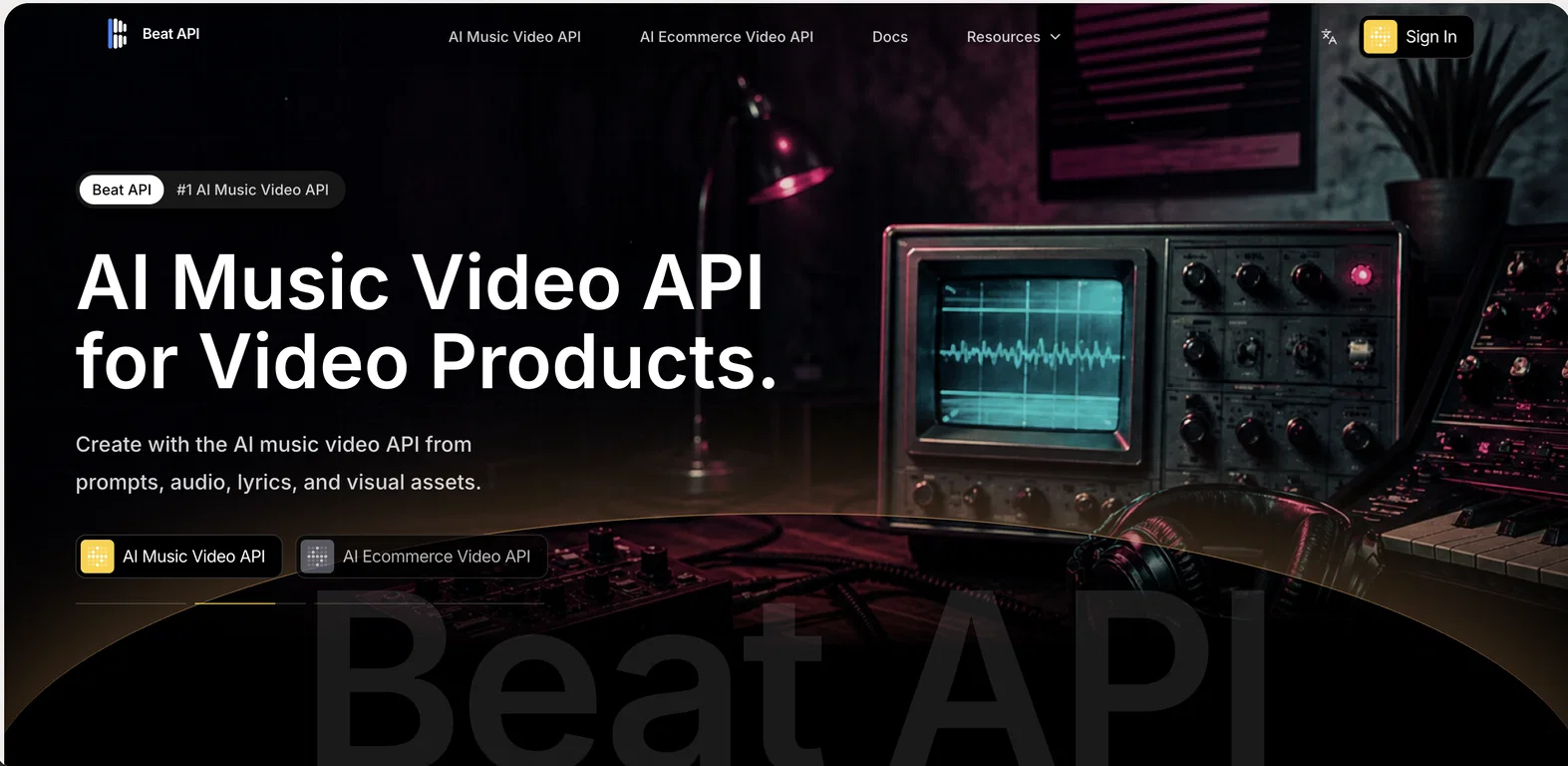
The Beat API AI Music Video API is designed for creating music videos using AI technologies. It provides an infrastructure to generate videos from prompts, audio, lyrics, and visual assets.
The API allows users to skip queue, polling, storage, and webhook glue with one asynchronous video workflow. Notably, this platform offers one asynchronous task for tasks such as generation, tracking, and output.
Furthermore, it returns a hosted MP4 for product-ready delivery. The Beat API is applicable in a range of areas including music apps, artist platforms, creator tools, and campaigns.
Among its potential uses, it can turn tracks into hosted AI music video output and generate ecommerce ad videos. Additionally, it can allow listeners, artists, and fan communities to create AI music videos from audio, lyrics, prompts, and references via one task.
This powerful tool also contains safeguards that enable the user to manage audio, lyrics, references, processing, billing, and delivery. Notably, it ensures every task traceable by retaining inputs, execution details, files, delivery events, and support traces on a single record.
For additional convenience, it provides capability for risk management by mitigating lyrics and asset mismatch risks and addressing unclear billing issues.
With this API, developers can submit music inputs only once and receive a task id for polling or status events.
Pros and Cons
Pros
Generates videos from prompts
Audio, lyrics and visual inputs
Allows skipping queue and polling
Offers asynchronous video workflow
Cons
No clear pricing
Complicated billing system
Limited video formats
No multi-language support
What is the main functionality of the Beat API AI Music Video API?
The main functionality of the Beat API AI Music Video API is to generate music videos using AI technologies from prompts, audio, lyrics, and visual assets.
How does the Beat API allow for the creation of music videos?
The Beat API enables the creation of music videos by providing an infrastructure that allows developers to submit prompts, audio, lyrics, and visual assets in one task. Once the inputs are submitted, the asynchronous workflow handles the generation of the video and the tracking and output process.
What kinds of tasks can the asynchronous workflow handle?
The asynchronous workflow in Beat API can handle tasks like the generation of music videos, tracking the status of these tasks, and managing the output process.